


Trademark Parody in a Business Context

Nowadays, marketing codes are greatly influenced by social media.
While the trend for professionals is to position themselves as close as possible to the consumer, adopting their codes, they are nonetheless subject to many more precautions.
Parody, pastiche, reference, or a subtle nod are all conceivable but risky strategies for professionals, who are not just any internet user…
June 2025
By Pierre Favilli,
Industrial Property Attorney,
Deputy Managing Director, LEGIMARK
Unlike copyright law, trademark law does not provide for a parody exception aimed at defending freedom of expression.
Indeed, the criterion, probably simpler to grasp, involves examining the use of another’s trademark in the course of trade. In other words, the parodic use of a trademark will not be condemned as long as it is not intended to seek a direct or indirect economic advantage within the scope of a commercial activity (ECJ, Case C-206/01, Court Judgment, Arsenal Football Club).
When a professional ventures into the realm of parody, it seems evident that they are seeking to promote their commercial activity and thus pursuing a direct or indirect economic advantage. The risk of conviction for trademark infringement therefore appears equally obvious.
Beyond the scope of trademark law and conviction for infringement (which seems straightforward to understand), the parodic use of another’s trademark exposes one to other types of risks, particularly in the area of civil liability.
On the Positive Use of Prior Trademarks
One of the major risks is damage to the reputation of a prior trademark, particularly the recognition of acts of parasitism, which consist of a set of behaviors by which an economic agent intrudes into the wake of another to profit without expending any of their own efforts or know-how.
Recently, Louis Vuitton Malletier initiated legal action against a toy manufacturer who reproduced its iconic logo on a suitcase-shaped product, itself inspired by an emoji (Paris Civil Court, April 25, 2024, No. 19/09163, Louis Vuitton Malletier, “Pooey Puitton” Case):
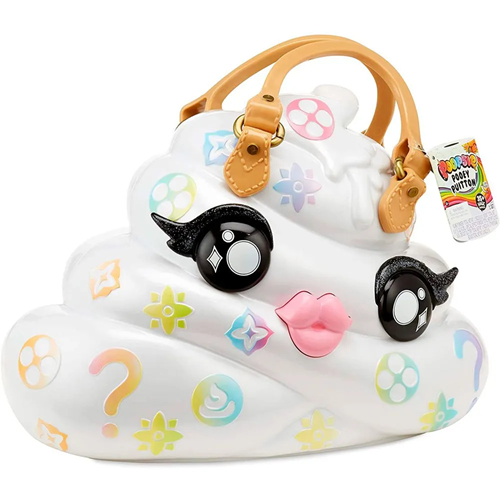
While the judges recognized the toy manufacturer’s parodic intent, they also inferred that it constituted an implicit acknowledgment of the grievance of parasitism, since the objective was to piggyback on Louis Vuitton’s reputation to unduly profit from the renown of its brand and products, even if done through humor or mockery.
They thus rejected the defense’s arguments that the toy manufacturer had made significant investments without benefiting solely from knowledge of the prior trademark, and the fact that the target audience (children aged 6 to 8) would immediately recognize a Poopsie range product and not a Louis Vuitton product, given that the relevant public is actually composed of the product’s purchasers, predominantly parents.
For these reasons, the judges thus recognized that the incriminated acts indeed constituted acts of parasitism, also leading to the dilution of the product’s image, and thus ordered the toy manufacturer to compensate for these two damages.
This case is reminiscent of Wilkinson’s conviction following its marketing stunt carried out on the eve of a match between France and New Zealand during the Rugby World Cup (Paris Civil Court, June 27, 2014, No. 12/12555 (FFR / Wilkinson – JWT):
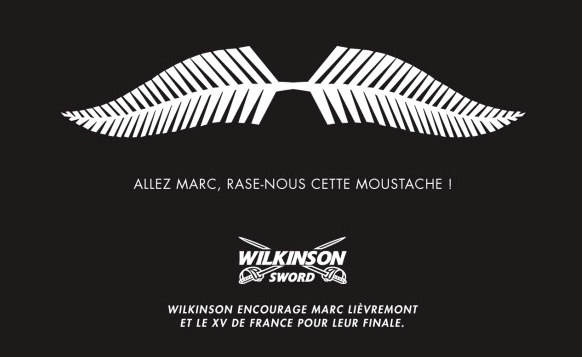
Note that in this advertisement, the mustache presented constitutes a misappropriation of the official logo of the New Zealand team, while the first name “Marc” refers to Marc Lièvremont, then-coach of the French team (XV de France).
The judges here considered that, given the context, Wilkinson sought to unduly capture the benefits of investments made by the French Rugby Federation, in that the subtitle associating the advertiser’s brand and the French national team led the public to believe that Wilkinson was a commercial partner of the FFR.
On the Negative Use of Prior Trademarks
In the business world, while criticism is not prohibited in principle, it must not, however, be tantamount to acts of disparagement.
A case opposing the trademark holders Nocciolata and Nutella offers interesting insights concerning criticism in a competitive context (Paris Court of Appeal, December 8, 2023, No. 22/04756, S.A.S. FERRERO FRANCE COMMERCIALE v. S.A.S. RIGONI DI ASIAGO France).
To promote its products, Nocciolata launched an advertising spot using the slogans “Nocciolata, it’s palm oil-free” and “Nocciolata, it’s organic and it’s good,” associated with a representation of an orangutan.

As a reminder, Ferrero, the owner of Nutella, is frequently criticized regarding the use of palm oil (whose production is held responsible for deforestation and thus, the disappearance of wildlife in certain regions of the world).
In this case, the judges considered that while it is true that Nutella holds a dominant position in the French spread market and enjoys significant renown, it nonetheless remains that the mere reference to the absence of palm oil in the Nocciolata product, even when associated with an orangutan, does not establish that the consumer will make a link between this advertisement and Nutella.
In its defense, Nocciolata also submitted an IFOP survey attesting that few of the surveyed individuals spontaneously cited Nutella after viewing the advertisement.
In the absence of a direct and obvious link between the author of the advertisement and its competitor, the judges therefore issued no conviction.
This case law teaches us that while criticism is not prohibited, it must be subtle!
LEGIMARK, a firm of industrial property attorneys, is at your disposal to support you upstream of all commercial projects and communication campaigns, in order to assess and eliminate potential legal risks.